
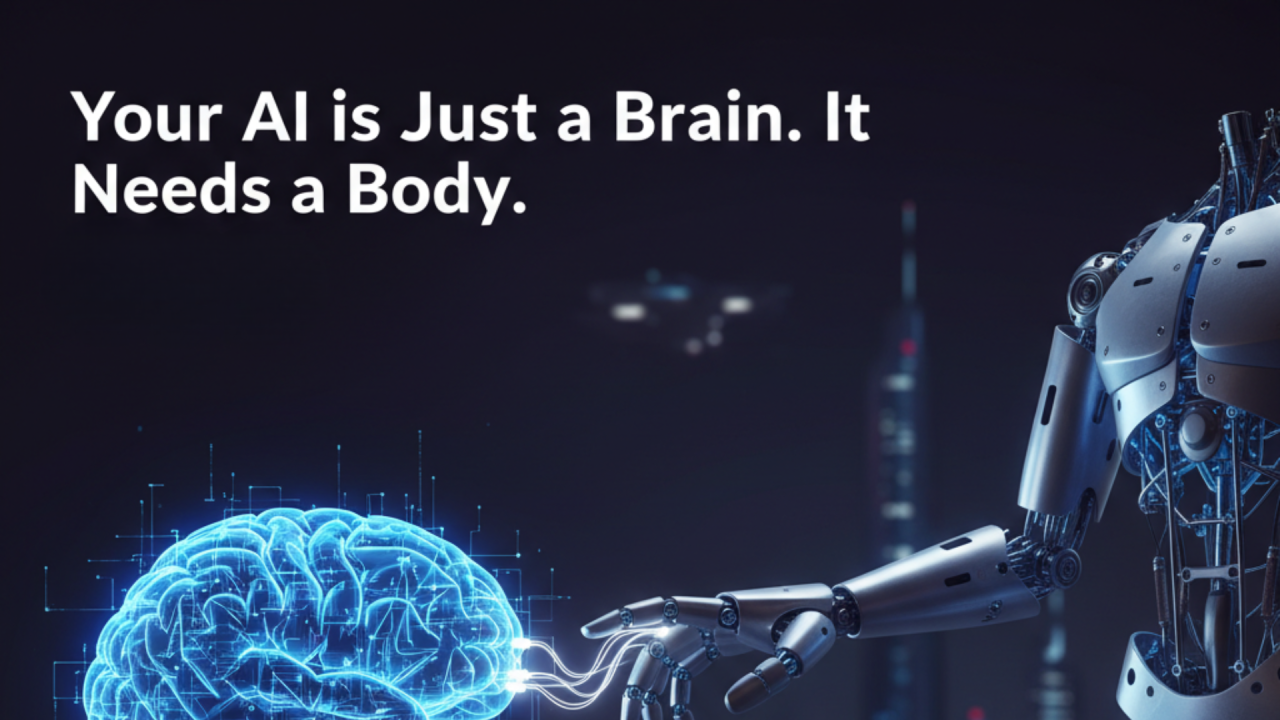
Your AI is Just a Brain. It Needs a Body.
You’ve mastered prompting Large Language Models (LLMs) like GPT-4. You can make them write code, summarise text, and even reason through complex problems. But if you’ve tried to build a truly dynamic application around them, you’ve likely hit a wall.
Why? Because an LLM, for all its power, is like a brain. It can think and reason, but it can’t interact with the world. It can’t take action, it can’t access live data, and it has no memory of its own.
This is the fundamental limitation that separates a simple chatbot from a truly intelligent system. To overcome it, we need to give our AI brain a body. We need to build an AI Agent.
The Brilliant Brain: Understanding the LLM
At its core, an LLM is a sophisticated statistical model designed to predict the next word (or “token”) in a sequence. This simple mechanism, scaled up with massive amounts of data, gives it the incredible ability to understand language, generate human-like text, and even perform logical reasoning.
But that’s where its native capabilities end. An LLM can’t:
- Interact with its environment: It can’t check a database, call an API, or read a file from your system.
- Take independent action: It can only provide you with text; it can’t execute the code it just wrote.
- Remember past interactions on its own: While platforms like Chat-GPT create the illusion of memory, this is an external feature built around the core LLM.
To make this tangible, think of the human brain. It’s the most powerful processing unit we know, but without eyes to see, ears to hear, and hands to act, it’s completely isolated.
The Complete System: The AI Agent as a Body
This is where the concept of an AI Agent comes in. An AI Agent is the “body” that connects the LLM “brain” to the outside world, giving it the ability to perceive, remember, and act.
Just like a human, an AI Agent has:
- Sensors (Input): Ways to receive information beyond a simple text prompt. This could be data from a live stock market API, the contents of a PDF report, or records from a customer database.
- Tools (Actions): Functions or code that the LLM can decide to execute. These are its “hands and feet,” allowing it to perform tasks like querying a database, sending an email, or analysing a file.
- Memory (Context): A system for retaining information from past interactions, observations, and actions, allowing it to build a coherent plan and execute multi-step tasks.
By combining these elements, we transform the LLM from a passive text generator into an active participant in a system—an autonomous agent that can reason, plan, and execute tasks to achieve a goal.
The Three Core Components of an AI Agent
To put it simply, every AI Agent is built on three pillars:
- The LLM (The Brain): The core reasoning engine that makes decisions.
- The Code (The Tools): The set of functions and capabilities the agent can use to interact with its environment.
- The Context (The Memory): The information the agent retains to inform its future decisions and actions.
When you build an application this way, something remarkable happens. You stop writing rigid, deterministic code. Instead, you provide the AI with a goal and a set of tools, and it figures out how and when to use them.
This is the paradigm shift that AI agents represent. But how do you actually build one without getting lost in the complexity? That’s where AI Agent Frameworks come in.
Stay tuned for Part 2, where I’ll dive into the world of AI Agent Frameworks like LlamaIndex, LangChain, and AutoGen, and help you choose the right toolkit for your next project.